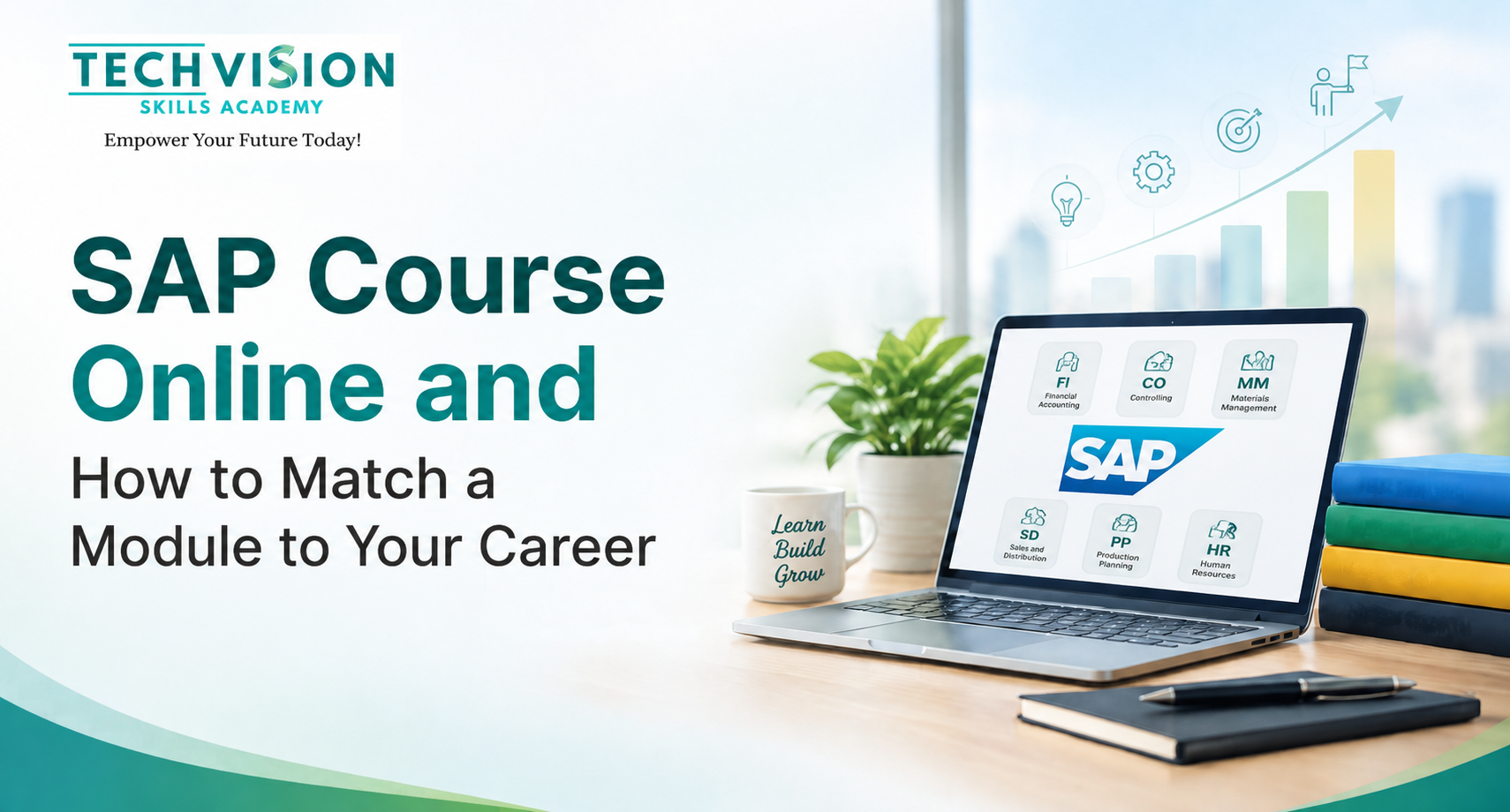
SAP Course Online and How to Match a Module to Your Career
TechVision
October 13, 2026
SAP
Many people who search for an SAP course online already know they want SAP skills but not which module to pick. That choice matters more than the platform or the price. A finance graduate and a supply chain executive need different training, even though both start from the same ERP system. This guide helps you choose by background, goal, and learning style.At TechVision Skills, we run several SAP S/4HANA programs. Below, we describe what each one covers and what you should ask any provider, so you can decide with clear information.
What SAP Is and Why Companies Use It
SAP is enterprise resource planning (ERP) software. It connects functions such as finance, purchasing, sales, production, and human resources in one system, so every department works from the same data. Because the modules share that data, a change in one area becomes visible in the others. SAP S/4HANA is the company’s current ERP suite, which is why most modern courses teach it.SAP splits its software into modules, and each module matches a business function. Choosing a course therefore means choosing a business function to specialize in.
SAP Modules at a Glance
Finance and Controlling
SAP FICO covers Financial Accounting and Controlling, and it suits commerce graduates and accountants. Our SAP S/4 HANA FICO course covers ledger accounting, receivables, taxation, bank accounting, assets, and controlling.
Materials Management and Sales and Distribution
SAP MM handles procurement, inventory, and vendor processes. SAP SD covers the sales cycle from inquiry and order to delivery and billing. Together they support the purchasing and order-to-cash flows that trading and manufacturing firms run. You can read more on our SAP MM andSAP SD pages.
Production Planning and Human Capital Management
SAP PP plans and tracks manufacturing activity, while SAP HCM supports human resources processes. Both appear on our course list as SAP PP andSAP HCM. Check each course page for the current syllabus before you decide.
ABAP and Cloud
SAP ABAP is SAP’s programming language, and its course suits learners who enjoy coding. The other modules above are functional, which means they focus on business processes and configuration rather than code. We also list anSAP ABAP course and an SAP cloud course for learners who want those paths.
Match a Module to Your Background
Your current work usually points to the right module. Familiar business processes shorten the learning curve, so you spend more time on SAP itself. Finance and accounts professionals often start with FICO. People working in procurement, stores, logistics, or supply chain can look at MM. Sales, marketing, and customer service professionals can consider SD.Graduates without work experience can choose by interest. Prerequisites differ by course. Our FICO course asks for basic accounting knowledge, while our MM and SD courses ask for basic computer knowledge. All three state that no prior SAP experience is required, and you should confirm eligibility for any course before you enroll. If you are undecided between two modules, read both syllabi and attend a demo for each.
Why Online SAP Training Suits Working Professionals
Online SAP training removes the commute and lets you fit lessons around a job. Weekday and weekend batches add flexibility, and recorded sessions help you revisit difficult topics. Our website describes these options for both online and classroom learners, which makes SAP courses for working professionals easier to plan. Self-paced study can slip without structure, so set fixed weekly practice hours and protect them.Flexibility only helps if you can practise. SAP skills develop on a live system, so confirm that any SAP online course includes server access before you enroll. Ask whether recordings stay available after the batch ends and how long the practice system remains open to you.
SAP Training with Practical Experience
Our SAP program begins with ERP basics, SAP S/4HANA architecture, navigation in SAP GUI and Fiori, and enterprise structure concepts. It then moves into core module training, configuration, and master data setup.Later stages cover end-to-end business cycles, requirement gathering, blueprint preparation, testing, and user acceptance. These steps follow the way SAP implementation projects run, so they give you real project vocabulary for interviews. Assignments, case studies, and mock interviews then help you connect each configuration step with the questions interviewers ask.Hands-on practice matters at every stage. Ask any provider how many hours of system practice you will get and whether trainers review your assignments.
SAP Certification Courses and Exams
SAP offers official certifications through SAP Training and Certification. SAP recommends combining education courses with hands-on experience, because exams test how you apply what you learned, as itsFinancial Accounting certification page explains.Certification is usually a separate step from a training course. SAP’s own academy course page states that the exam is booked separately after the training. Our SAP program includes certification guidance, while SAP itself conducts the exam. Plan your preparation around the exam outline published by SAP, because each certification lists its topic areas and their weightings.
SAP Career Paths and Skills
SAP careers include functional, technical, and support roles. Functional consultants configure modules to match business needs. Technical consultants build custom programs, usually with ABAP. Support consultants resolve user issues and keep processes running.Freshers can begin as SAP end users or junior consultants, a path our SAP course page also describes. Beyond system knowledge, these roles reward business process understanding, careful documentation, and clear communication with users. Career growth usually comes from deepening one module first and then adding related ones, such as MM and SD together, which reflects how those processes connect in real companies.
Common Mistakes When Choosing SAP Training
A frequent mistake is choosing a module because it is popular rather than because it fits your background. A finance professional gains more from FICO than from a module with no link to daily work. Another mistake is comparing only fees, which hides differences in system access and trainer support.Some learners skip the demo session, even though a demo shows how the trainer explains processes and handles doubts. Others forget to check the SAP version taught. A syllabus built only on older versions may not reflect the S/4HANA systems that companies now adopt.
How to Choose an SAP Course Online for Your Goal
Career switchers should look for beginner-friendly teaching, interview preparation, and internship support. Working professionals should check batch timings and recorded sessions. Developers should compare ABAP syllabi, since those courses stress programming practice more than business configuration.Whatever your goal, compare at least three providers on the same points. Check the SAP version taught, system access, trainer experience, assignment and project work, and the terms of placement support. Ask about fees and installment options directly, because fees and eligibility vary between providers and courses.Treat job guarantees with caution. Placement outcomes depend on individual performance and eligibility, and any provider that promises a job without conditions deserves questions.
How TechVision Skills Supports SAP Learners
Our SAP program is an industry-oriented course taught in hybrid mode. It covers SAP S/4HANA with practical system access and real-time business scenarios. Individual courses are also available for FICO, MM, SD, PP, HCM, ABAP, and cloud.Our placement support includes ATS-friendly resume preparation, LinkedIn profile optimization, mock technical interviews, interview referrals, and internship support. Our office is in Deccan Gymkhana, Pune, and the team can guide you toward the right module on a call.
Conclusion
The right SAP course online for career growth is one that matches your background, teaches S/4HANA on a live system, and states its terms clearly. Pick the module first and the provider second, and give yourself time to compare syllabi before you pay.If you are unsure where to start, reach out through our contact page for a personalized course recommendation and a demo session. Our team can compare modules with you based on your education and work history.
Frequently Asked Questions
What is an SAP course online?
It is training in SAP software delivered through live or recorded online sessions. Courses are usually organized by module, such as finance, procurement, sales, production, human resources, or programming. Quality depends on the syllabus and access to a practice system.
Which SAP module should a beginner choose?
SAP training for beginners should start with the module closest to your education or work background, such as FICO for finance or MM for procurement. Familiar business processes make SAP terms easier to learn.
What are the main SAP modules?
Common modules include FICO, MM, SD, PP, HCM, and ABAP, along with newer cloud offerings. Each one supports a business function or a technical role. Our course list covers all of these.
What is the eligibility for an SAP course?
SAP course eligibility depends on the course and provider. Our FICO course asks for basic accounting knowledge, while our MM and SD courses ask for basic computer knowledge. Our course pages state that no prior SAP experience is required.
Can non-IT graduates learn SAP?
Yes. Functional modules focus on business processes, so commerce, management, and finance graduates can learn them. Our course pages list non-IT professionals among the learners who can enroll.