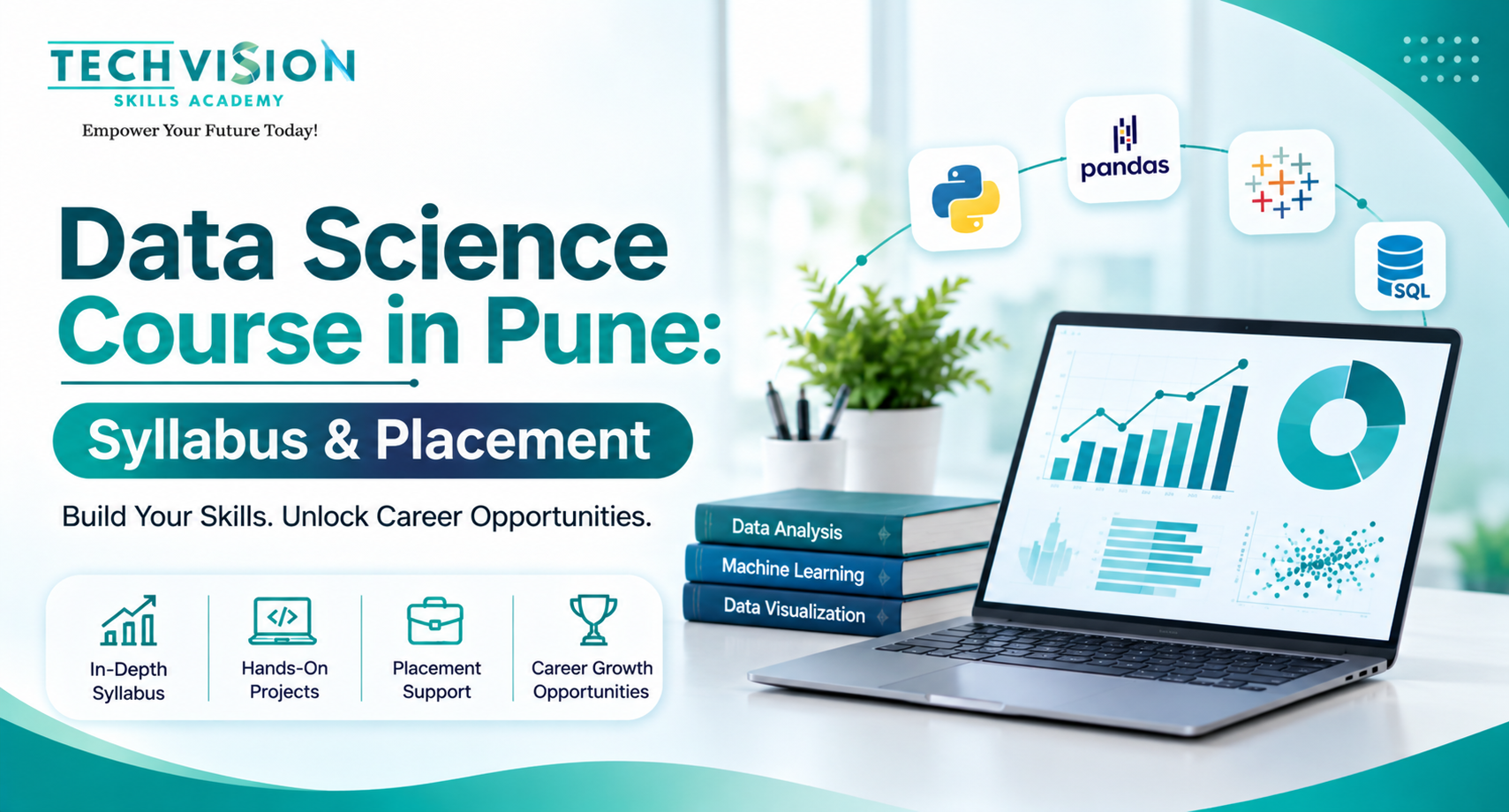
Data Science Course in Pune: Syllabus, Tools and Career Scope with AI and ML
SEO Admin
November 10, 2026
Data & Analytics
Data science courses are often advertised as a list of tools. That list matters less than how the topics build on one another, because the order decides whether you finish with working skills or a folder of half-understood notebooks. This article maps what a data science course in Pune should cover, which tools matter at each stage and which career paths the skills can support. It is a general learning map, not a description of any one institute’s syllabus, so compare it against whatever syllabus you are shown.
Data science and data analytics are related, not identical
Data analytics focuses on describing what happened and why, using SQL, spreadsheets and dashboards. Data science extends into prediction: building models that estimate what is likely to happen, such as customer churn or next month’s demand. The two share many skills, and plenty of people begin in analytics before moving towards modelling. If you are unsure where to start, TechVision Skills lists both a data analyst programme and a Data Science with AI & ML programme on its site, and comparing the two outlines is a fair exercise.
Where AI and machine learning fit
Artificial intelligence is the broad goal of building systems that perform tasks needing human-like judgement. Machine learning is a subset in which models learn patterns from data instead of following hand-written rules. Data science is the wider practice of collecting, cleaning, analysing and modelling data, and machine learning is one of its main tools. Deep learning and generative AI sit further inside that picture. A well-ordered course teaches classical machine learning before neural networks, because the evaluation habits carry over.
The foundation: statistics and Python
Skip this layer and models become black boxes. You need descriptive statistics, probability basics, distributions, correlation, hypothesis testing and an instinct for sampling bias. Linear algebra and calculus matter at a conceptual level: vectors, matrices and gradients explain how models learn, though you will rarely derive them by hand. For programming, learn Python fundamentals first, including data types, loops, functions and file handling. Only then move to NumPy and pandas. Learners who rush into scikit-learn without this base usually struggle once the data gets messy.
Handling and understanding data
Real datasets arrive with missing values, duplicates and inconsistent formats. Expect to spend a large share of any project cleaning data with pandas. SQL is equally important, because most business data sits in relational databases. Joins, aggregations, subqueries and window functions are the minimum. Exploratory data analysis ties this together: you summarise the data, plot distributions with Matplotlib or Seaborn, look for outliers and relationships, and form hypotheses before building a model. A course that jumps straight to algorithms skips the step that makes models trustworthy.
Machine learning fundamentals
Start with supervised learning: linear and logistic regression, decision trees, random forests and gradient boosting. Then cover unsupervised methods such as clustering and dimensionality reduction. The part many courses underteach is evaluation. Learn train-test splits, cross-validation, overfitting and metrics suited to the problem, such as RMSE for regression, and precision, recall and F1 for classification, especially with imbalanced classes. Add feature engineering and basic model tuning. Scikit-learn is the standard learning tool here, and TechVision Skills also lists machine learning as a separate course.
AI topics worth learning next
Once classical machine learning feels comfortable, an introduction to neural networks with TensorFlow or PyTorch is reasonable. Natural language processing, including text cleaning and embeddings, is a common next step, as is an awareness of how large language models are used inside applications. Treat these as extensions, not replacements. A learner who can validate a simple model properly is better prepared than one who has run a pretrained model without understanding its limits.
Projects that show real understanding
A project should start with a question, not a dataset. Examples include predicting customer churn for a subscription business and explaining its main drivers, forecasting weekly sales and comparing a simple baseline against a model, classifying support tickets by topic using text features, or segmenting customers with clustering and describing each segment in plain language. Whatever you choose, document the problem, data source, cleaning decisions, model comparison and limitations. Public datasets are fine, provided the analysis is your own.
Tools you will keep meeting
Python, Jupyter Notebook and Git/GitHub
NumPy and pandas for data handling
Matplotlib and Seaborn for visualisation
SQL with MySQL or PostgreSQL
scikit-learn for classical machine learning
TensorFlow or PyTorch for deep learning basics
Power BI or Tableau for sharing results as dashboards
Before you start, and how long it takes
You do not need an advanced degree, but you do need basic mathematical comfort and a willingness to write code regularly. Non-IT graduates can learn this path, though they should plan extra time for Python and statistics. Duration varies by institute and by how much practice you add yourself, so ask for the number of teaching hours and the number of hands-on hours, not just a week count.
Career roles, stated honestly
These skills support roles such as data analyst, business analyst, BI developer, junior data scientist and, with more experience, machine learning engineer. Entry-level data scientist openings are competitive, and many learners reach modelling work through analyst roles first. Hiring depends on your portfolio, communication and interview performance, not on a course certificate alone. Read current job postings for the roles you want and note which skills they ask for.
Building a portfolio and judging a course
Publish three or four projects on GitHub with clear README files and short plain-language case studies. When you evaluate any data science course in Pune, ask whether you will build such projects, whether SQL and statistics are taught properly and who reviews your work. Attend a demo, request the topic-wise syllabus and compare it with the map above. TechVision Skills offers a free demo and counselling that you can request through its contact page.
FAQs
1. Do I need a coding background to join a data science course in Pune?
Not necessarily. Python can be learned from scratch, and a well-structured course starts with fundamentals. Comfort with basic maths and logical thinking helps, and non-IT learners should plan extra practice time.
2. Which maths topics should I revise before starting?
Focus on basic statistics, probability and elementary algebra. Linear algebra and calculus are easier once you meet them through machine learning examples, so you do not need to master them in advance.
3. Is machine learning the same as data science?
No. Data science covers the whole process of collecting, cleaning, analysing and modelling data. Machine learning is one set of techniques within it, used mainly for prediction and pattern detection.
4. Can a data analyst move into data science?
Yes, and it is a common path. Analysts already work with SQL, data cleaning and visualisation. The additional skills are statistics for modelling, Python-based machine learning and model evaluation.
5. What roles can I apply for after learning data science?
Common roles include data analyst, business analyst, BI developer and junior data scientist. Outcomes depend on your portfolio, communication skills and interview performance, so no course can guarantee a particular role.