


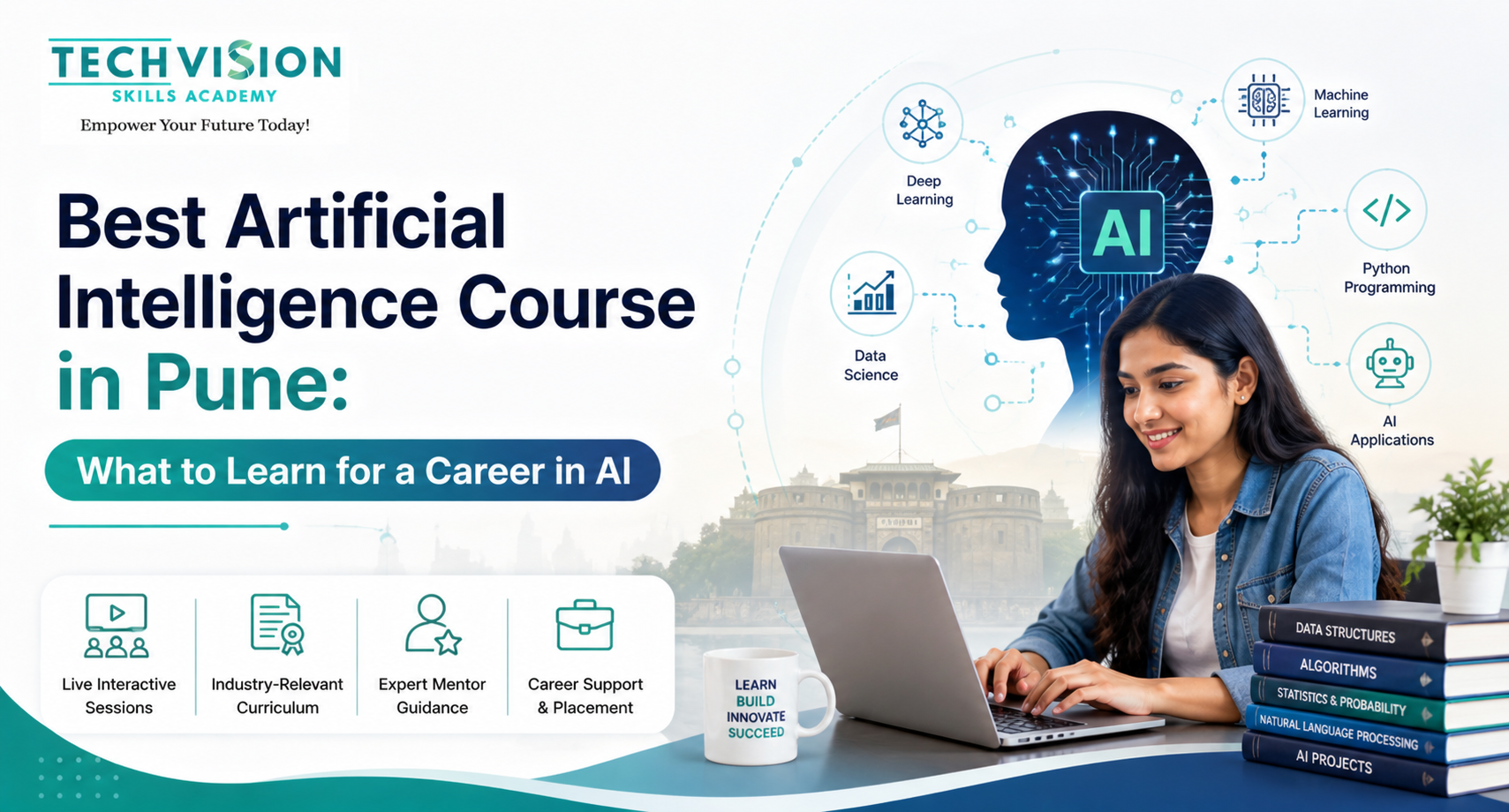
Best Artificial Intelligence Course in Pune: What to Learn for a Career in AI

  • TechVision
  • October 23, 2026

  • Artificial Intelligence

Blog-Image
The best artificial intelligence course in Pune is the one that teaches the complete AI workflow and makes you prove it with projects. That means Python and data preparation, machine learning, natural language processing, and generative AI, all practiced on real tasks and not only explained on slides. Most learners who search for an artificial intelligence course in Pune share one worry. They cannot tell which course will leave them able to do the work. This guide shows what to learn, in what order, and how to check any course against that list, including ours. If you want a plain introduction to AI first, our AI training guide covers the basics.

Quick Facts About the TechVision Skills AI Course

Detail Information
Course Artificial Intelligence, Data Science and AI track
Provider TechVision Skills Academy LLP, Deccan Gymkhana, Pune
Duration 2 months (40 hours), as listed on the course page
Mode Online and offline batches
Prerequisites Basic computer skills, no technical background required
Trainer Hrishikesh Jadhao
Projects Four hands-on AI projects
Support Mock tests, interview preparation, internship and placement guidance

What to Learn in an Artificial Intelligence Course

A useful AI syllabus follows the path of a real AI project. You collect and clean data, train and test a model, and then turn it into something people can use. Here is that path, with what you should be able to do at each stage.

Stage 1. AI foundations and Python

Start with what AI, machine learning, and generative AI mean, and where each one is used. Python is the working language of the field, so a good course teaches it with machine learning in mind. By the end of this stage, you can write short Python scripts that load and handle data.

Stage 2. Data preparation and exploration

Models are only as good as the data behind them. Data preprocessing and exploratory data analysis (EDA) teach you to fix missing values, spot unusual records, and understand patterns before training anything. You should leave this stage able to turn a messy dataset into one a model can learn from.

Stage 3. Machine learning algorithms

Supervised learning predicts a known outcome, such as whether a customer will leave. Unsupervised learning finds groups in data that has no labels. Feature engineering and model evaluation and tuning then teach you to improve results and measure them honestly. You should be able to choose an algorithm, train it, and explain how well it performs.

Stage 4. Natural language processing

Natural language processing (NLP) lets software work with text such as reviews, emails, and resumes. You learn to turn raw text into input a model can use. The practical outcome is a basic text-based tool you built yourself.

Stage 5. Generative AI, LLMs, and prompt engineering

Generative AI creates new text, images, or code. Large language models (LLMs) power chatbots and writing assistants. Prompt engineering is the skill of writing clear instructions so these models return useful answers. Our course includes hands-on use of LLMs and NLP tasks, so you practise this and do not only read about it.

Stage 6. Deployment concepts and AI use cases

A model that stays in a notebook helps no one. Deployment concepts explain how a trained model reaches users, and AI use cases show where businesses apply it. You should be able to describe how an AI solution moves from idea to everyday use.

Projects That Prove Your Skills

Interviewers ask what you have built, not only what you have studied. Our course page lists four projects.
  • AI chatbot using prompts shows that you can work with LLMs and write effective prompts.
  • A resume analyzer using NLP applies text processing to a document everyone understands.
  • Recommendation model shows how data drives suggestions, the idea behind many shopping and streaming features.
  • Image classification with a basic neural network gives you a first working neural network.
The course page also lists AI internships covering NLP tasks, AI automation, model improvement, and data annotation projects, along with placement guidance. Keep every project in a public folder with a short write-up of the problem, the data, the method, and the result.

How to Judge the Best Artificial Intelligence Course in Pune

Every institute calls its course the best. Use these checks instead of slogans.
  1. Ask for the syllabus in writing. It should name machine learning, NLP, and generative AI, and not only list tools. You can download ours from the course page.
  2. Ask to see finished projects. A provider confident in its teaching can show what learners build.
  3. Ask who teaches and how doubts are handled. Regular access to the trainer matters more than recorded lectures alone.
  4. Check that practice uses real tasks. Look for LLM tools, NLP exercises, and datasets, not only theory.
  5. Read the certificate rules. At TechVision Skills, learners need at least 80 percent attendance, a completed project, participation in mock tests, and finished practical assignments.
  6. Treat guarantees with caution. No course can promise a job. Look for concrete support such as interview preparation, mock tests, and internships.

Who This AI Course Suits

The course page sets basic computer skills as the only prerequisite and says no technical background is required. It lists freshers, non-IT learners moving into AI, and working professionals who want to upskill. If you already know Python and want more depth after this course, you can continue with our Machine Learning, Data Science with AI and ML, or GenAI and Agentic AI courses.

AI Careers and the Skills Behind Them

The World Economic Forum’s Future of Jobs Report 2025 lists AI and big data among the fastest-growing skills through 2030. Entry points usually sit close to what you practised in training.
  • Data preparation and machine learning skills point toward junior machine learning and data science roles.
  • NLP and LLM skills point toward text-focused and generative AI application roles.
  • Prompt engineering and automation projects point toward AI automation work.
Most people start with internships or junior roles and grow from there. For a stage-by-stage plan beyond this course, read our AI career roadmap. To understand why Pune suits AI learners, see our guide on enrolling in an AI course in Pune.

Online or Classroom Artificial Intelligence Training in Pune

Our AI course runs in online and offline batches. Our website describes weekday and weekend batches, recorded sessions, live doubt solving, and continuous mentor support. Working professionals often prefer online batches for flexibility. Learners who like in-person guidance can attend at our Deccan Gymkhana centre.

How We Teach Artificial Intelligence at TechVision Skills

TechVision Skills Academy LLP is an IT training centre based in Deccan Gymkhana, Pune. Our AI course moves from Python and data preparation to machine learning, NLP, generative AI, and deployment concepts, and ends with interview preparation. Learners practise on projects, take mock tests, and receive guidance on internships and placement. Want to see the syllabus and meet the team before you decide? Book a free demo session and ask for free career counseling. You can also call +91 8767261158 or write to info@techvisionskills.com. Our office hours are Monday to Saturday, 9:30 AM to 7:30 PM, and Sunday, 10:00 AM to 4:00 PM.

Frequently Asked Questions

What is the best artificial intelligence course in Pune?

There is no official ranking. The best course is the one that fits your background and teaches the full workflow of Python, machine learning, NLP, and generative AI with real projects. Use the checklist above to compare providers, including TechVision Skills.

What should I learn in an artificial intelligence course?

 Learn Python basics, data preprocessing and EDA, supervised and unsupervised learning, model evaluation, NLP, generative AI with LLMs, prompt engineering, and deployment concepts

Is artificial intelligence training in Pune suitable for non-IT beginners?

Yes. Our course page requires only basic computer skills and states that no technical background is needed.

Do I need to know coding before joining?

 No. The first module covers Python basics for machine learning.

How long is the AI course at TechVision Skills?

 Our course page lists 2 months and 40 hours. Please confirm current batch schedules with our team before you plan.
Call Our Counselor

    Get In Touch With Us