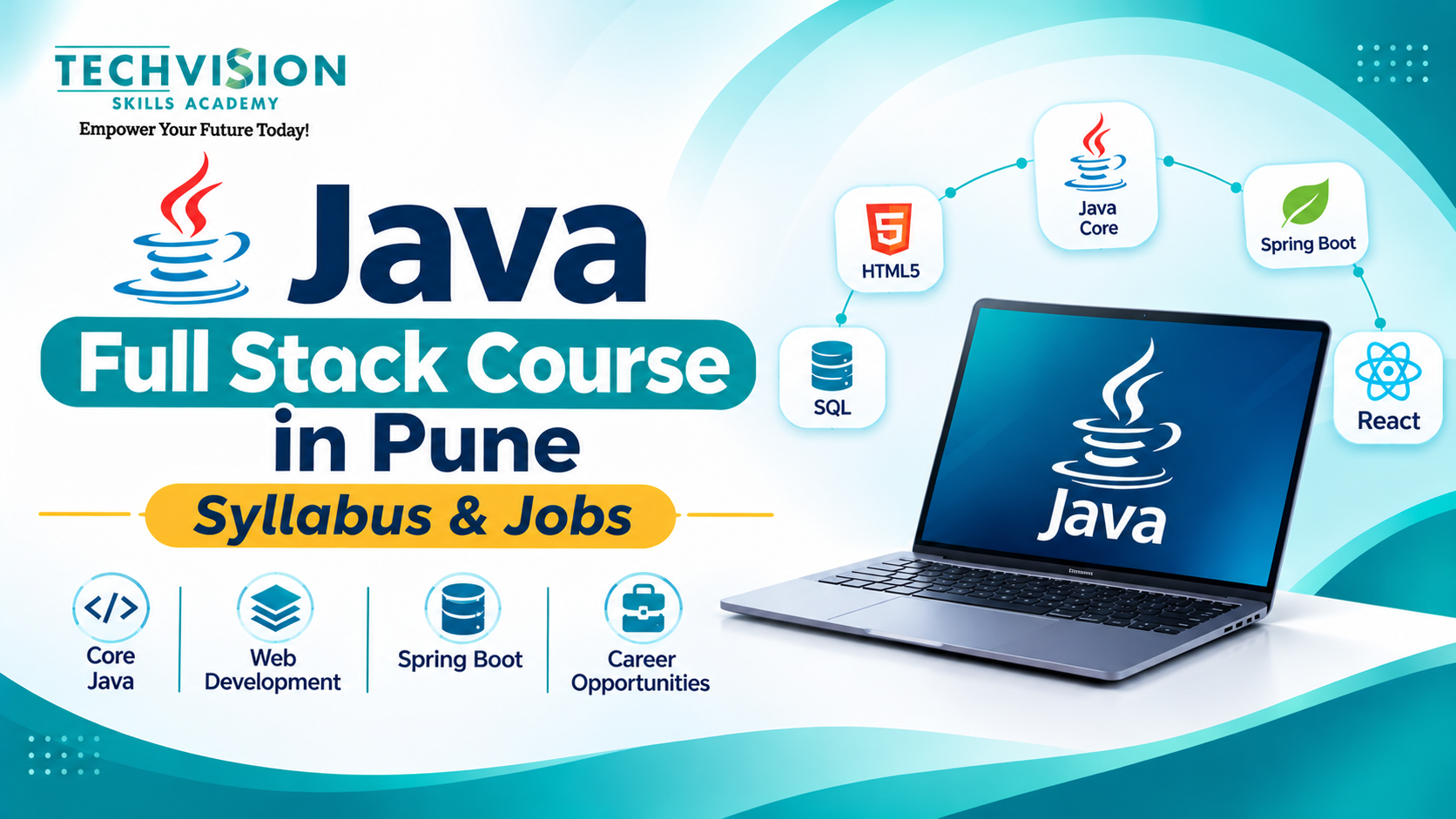
Java Full Stack Developer Course in Pune: Syllabus, Projects and Job Roles
TechVision
November 17, 2026
Java full stack
Most people searching for a java full stack developer course in Punewant the same thing: to know what they will be able to build at the end. The answer depends on how well the course sequences Java, databases, web technologies and frameworks. This article walks through that stack layer by layer, separates essentials from advanced topics, suggests projects worth building and describes the roles these skills can lead to. It is a general guide, not a statement of any specific institute’s curriculum.
What a Java full-stack developer does
A full-stack developer works on both sides of a web application. On the visible side, they build screens users interact with. On the server side, they write the logic, security rules and database access behind those screens. In a Java stack, the backend is typically Java with Spring Boot, the frontend is HTML, CSS, JavaScript and often React, and data lives in a relational database. One person rarely masters every layer. Expect to be stronger on one side and competent on the other.
Core Java comes first
Everything else rests on it. Cover data types, control flow, methods, then object-oriented programming in depth: classes, inheritance, polymorphism, abstraction and encapsulation. Add the collections framework (List, Set, Map), exception handling, strings, generics, file handling and the Java 8 features that appear in real code, such as lambda expressions and streams. Basic multithreading is useful. Learners who treat Core Java as a quick warm-up tend to hit a wall in Spring Boot, where annotations and dependency injection assume solid object-oriented thinking.
Databases, SQL and JDBC
Most applications store data in a relational database, so SQL is not optional. Learn table design, primary and foreign keys, joins, grouping and basic indexing. JDBC then shows how Java connects to a database, runs queries and handles results. It is worth learning even though you will later use Spring Data JPA and Hibernate, because it explains what those tools do on your behalf. TechVision Skills lists MySQL as a standalone course, which some learners take if they want extra database practice.
Frontend: web fundamentals, then React
Begin with semantic HTML, CSS layouts and responsive design. Then learn JavaScript properly: variables, functions, arrays and objects, DOM manipulation, asynchronous code and calling APIs with fetch. React comes after that, not before. Focus on components, props, state, hooks, forms, routing and consuming REST endpoints. Angular is a valid alternative in some companies, but React is common enough that many courses choose it. Either way, a learner who understands JavaScript will pick up the framework far faster.
Spring Boot and REST APIs
Spring Boot is where Core Java turns into working backend software. Key topics are project setup with Maven or Gradle, controllers, services, repositories, dependency injection, Spring Data JPA, validation, exception handling and Spring Security basics, including how token-based authentication works. A REST API exposes your data and actions to the frontend over HTTP, so you should be comfortable with status codes, request and response bodies and testing endpoints with Postman. Learning one framework does not make you job-ready. Interviewers still check Java, SQL and problem-solving.
Connecting the layers, and working like a developer
Integration is where many learners discover gaps. Your React app calls your Spring Boot API, which queries your database, and a failure in any layer can look like a failure in another. Learn to read browser developer tools, application logs and stack traces. Use Git and GitHub from the start for branching, commits and pull requests. Write unit tests with JUnit and Mockito for service logic. Debugging calmly and methodically is a skill employers notice quickly.
Essentials versus advanced topics
Essentials for an entry-level profile: Core Java and OOP, collections, SQL, HTML, CSS, JavaScript, React basics, Spring Boot with REST APIs, JPA, Git and basic testing. Advanced topics: microservices, Docker, message queues such as Kafka, design patterns, caching, CI/CD and cloud deployment. Advanced topics matter for career growth, but they build on the essentials. A course that spends weeks on microservices before you can write a clean REST controller has its priorities reversed.
Projects worth building
Choose projects with real data relationships and user roles. An inventory management system with login and role-based access, a library or appointment booking application, an expense tracker with monthly reports, or a mini e-commerce backend with cart and order logic all work well. Each should include a database design, REST API, React frontend, validation, error handling and a README explaining setup and design decisions. Two or three well-built projects you can explain line by line are worth more than ten copied ones.
Job roles and what employers look for
These skills prepare you for roles such as junior Java developer, backend developer, full-stack developer, software engineer trainee and, with additional testing skills, QA automation roles. Entry-level hiring typically screens Core Java, SQL, one framework, project explanation and logical reasoning. Practise data structures and common coding problems alongside your course, since many interviews include them. Outcomes depend on your preparation and the hiring market, not just on completing a syllabus.
What to check before enrolling
Ask for a topic-wise syllabus and check that Core Java and SQL get proper time. Confirm that you will write code every session and that someone reviews your project work. Ask whether projects are individual or shared. You can read about TechVision Skills’Java Full Stack Development programme and request a free demo through its contact page.
FAQs
Do I need programming experience before joining a java full stack developer course in Pune?
Not always. Many courses start from the basics, so freshers and non-IT learners can begin. Regular practice matters more than prior experience, because Core Java concepts take repeated coding to settle.
How do I know I am ready to start Spring Boot?
You should be able to write classes with inheritance and interfaces, use collections, handle exceptions and run basic SQL queries. If those feel comfortable, Spring Boot will make more sense.
Should I learn React or Angular?
Both are used in industry. React is widely taught and has a large ecosystem, so it is a reasonable default. Choose whichever your course covers well and focus on JavaScript fundamentals first.
How many projects should be in my portfolio?
Two or three solid projects are usually better than many shallow ones. Include at least one with authentication, database relationships and a working frontend, and be ready to explain your design choices.
What entry-level roles can I prepare for?
Common roles include junior Java developer, backend developer, full-stack developer and software engineer trainee. Employers also test SQL, problem-solving and communication, so prepare for those alongside your technical stack.