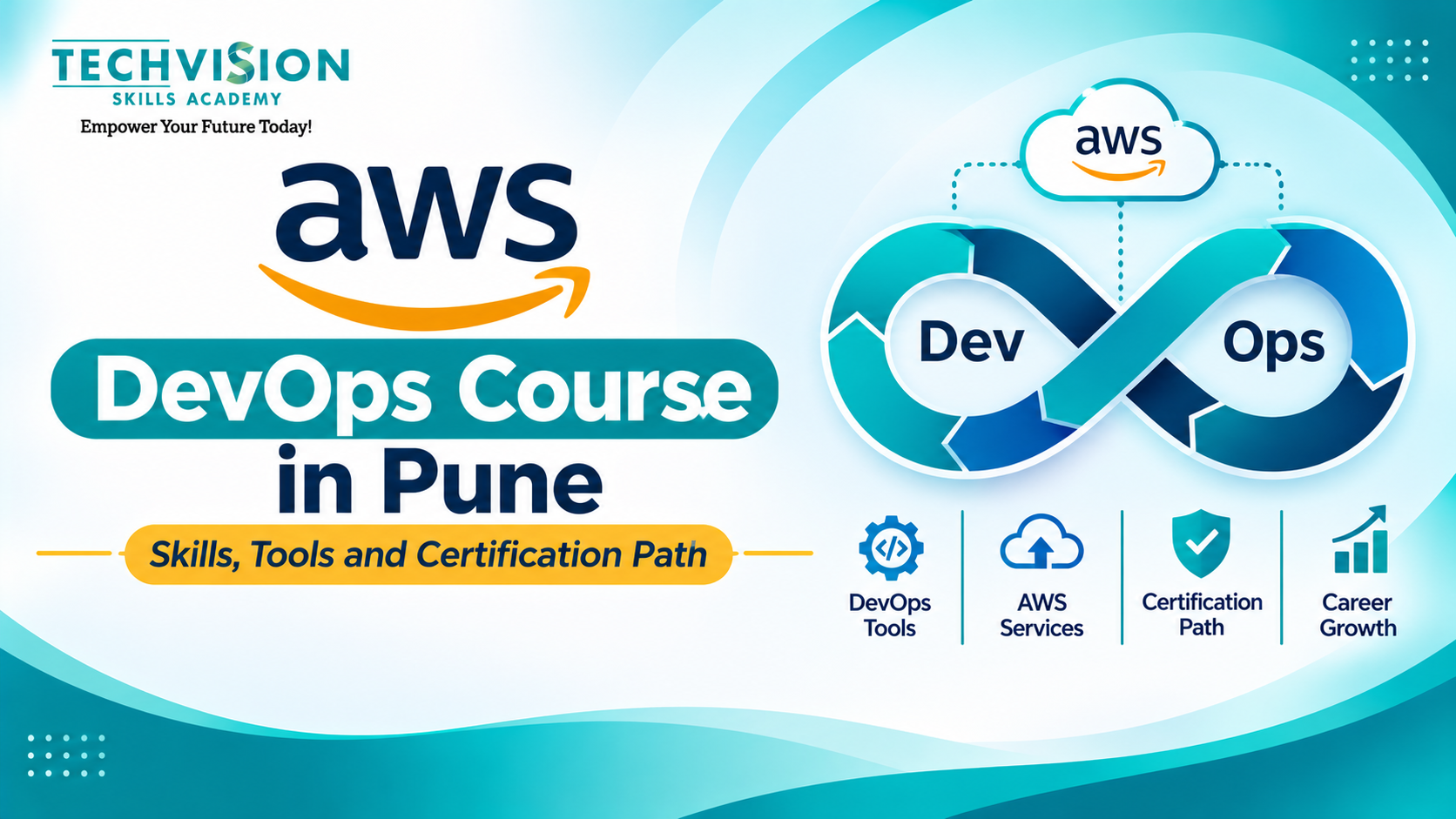
AWS DevOps Course in Pune: Skills, Tools and Certification Path
TechVision
November 17, 2026
AWS training in Pune
DevOps job descriptions list a long string of tools, and course brochures copy them. That makes it hard to tell what you actually need to learn and in what order. This article breaks down the skills and tools an AWS DevOps course in Pune should cover, explains how the AWS certification path works and describes the roles these skills can support. It is a general learning guide, not a claim about any institute’s exact syllabus or credentials.
What DevOps is, and where AWS fits
DevOps is a way of working that brings development and operations together so software can be built, tested, released and monitored quickly and reliably. It relies on automation, version control, repeatable environments and feedback from production. AWS supplies the infrastructure and many of the managed services that make this practical: compute, storage, networking, container platforms, pipeline services and monitoring. You can practise DevOps on other clouds, but AWS has a large share of the job market, which is why many learners pair the two.
Foundations before tools
Four foundations save the most time later. First, Linux: the command line, file permissions, processes, package managers and log files, since most servers run Linux. Second, networking basics, including IP addressing, subnets, DNS, ports and firewalls, because AWS VPC design assumes them. Third, cloud concepts such as regions, availability zones, shared responsibility and pay-as-you-go pricing. Fourth, scripting with Bash and basic Python to automate repetitive work. TechVision Skills lists a broader cloud computing course for learners who want a gentler start.
Version control and CI/CD
Git is the starting point: branches, merges, pull requests and resolving conflicts. Continuous integration means every code change is built and tested automatically, and continuous delivery means that tested code can be released with little manual effort. Jenkins is a common teaching tool because it exposes the moving parts, such as pipelines, agents and plugins. GitHub Actions and AWS CodePipeline, CodeBuild and CodeDeploy are other options. Learn the concepts first, since the same ideas carry across tools.
Containers and Kubernetes
Docker packages an application with its dependencies so it runs the same everywhere. Learn to write Dockerfiles, build images, use registries such as Amazon ECR, and run multi-container setups with Docker Compose. Kubernetes then orchestrates containers at scale. For a first course, focus on pods, deployments, services and basic troubleshooting rather than cluster internals. On AWS, Amazon ECS and Amazon EKS are the main managed container options. Treat Kubernetes as a second-stage skill, since it makes little sense without Docker and Linux.
Infrastructure as Code
Clicking through the console does not scale or repeat. Infrastructure as Code describes servers, networks and permissions in files you can review and version. Terraform is cloud-neutral and widely used; AWS CloudFormation is native to AWS. You do not need both at the start. Pick one, learn variables, state or stacks, modules or nested templates, and how to destroy resources cleanly so you do not leave charges running.
Monitoring, logging and troubleshooting
A pipeline that deploys successfully is only half the job. Learn Amazon CloudWatch for metrics, logs and alarms, AWS CloudTrail for tracking API activity, and IAM for least-privilege access. Add basic incident habits: reading logs, tracing a failure to its source and writing a short summary of what broke and why. Prometheus and Grafana appear in many teams too. Troubleshooting ability often separates candidates in interviews more than tool lists do.
Projects that prove practical skill
Build something end to end. For example, containerise a small web application, push the image to ECR, deploy it to ECS or EKS, and provision the network and servers with Terraform or CloudFormation. Add a CI/CD pipeline that tests and deploys on every commit, with CloudWatch alarms for failures. Document the architecture in a diagram and README. Remember to delete resources after practice, because cloud costs accumulate quickly.
The certification path
AWS certifications are exams taken with AWS, not something a course awards automatically. The typical ladder starts with AWS Certified Cloud Practitioner (foundational and optional for those with some experience), moves to associate-level exams such as Solutions Architect, Developer and CloudOps Engineer (previously SysOps Administrator), and reaches AWS Certified DevOps Engineer – Professional, which assumes substantial hands-on experience. AWS revises exam names and content, so check its official certification pages and exam guides before you plan. Exam fees are paid to AWS and are usually separate from course fees.
Learning tools is not the same as passing an exam
A practical course teaches you to build and fix things. Certification exams test breadth across services, scenarios and best practices, often under time pressure. They overlap but are not identical. Many learners do the course first, then spend extra weeks on practice questions and service-level reading. If an institute says it prepares you for certification, ask what that preparation includes. If AWS partnership status matters to you, ask for verifiable proof of it.
Prerequisites, roles and what to check
You do not need a software engineering background, but you should be comfortable with a command line and basic programming logic. Roles these skills can support include cloud support engineer, junior DevOps engineer, build and release engineer, systems administrator moving to cloud, and site reliability trainee. Outcomes depend on projects, interview performance and the market. Before choosing an AWS DevOps course in Pune, check that labs use real AWS accounts, that Linux is covered properly and that you will build projects. You can read about the TechVision SkillsAWS DevOps programme and speak to its counsellors through the contact page.
FAQs
Do I need coding skills before an AWS DevOps course in Pune?
Basic scripting helps, but advanced programming is not required. Comfort with the Linux command line and simple logic matters more. You can build scripting skills during the course with regular practice.
Does completing the course give me an AWS certification?
No. AWS certifications are earned by passing exams conducted by AWS. A course can prepare you with knowledge and practice, but the exam is taken and paid for separately.
Which AWS certification should a beginner consider first?
AWS Certified Cloud Practitioner is a common starting point for people new to cloud. After hands-on practice, many move to an associate-level exam. Check AWS’s official pages for current exam details.
Which practical projects show DevOps skills best?
A containerised application deployed on AWS with a CI/CD pipeline, infrastructure written as code and monitoring alarms shows the full workflow. Document your design and what you learned from failures.
What entry-level roles can AWS and DevOps skills lead to?
Typical starting points include cloud support engineer, junior DevOps engineer, build and release engineer and systems administrator roles. Results depend on your projects, interview preparation and current hiring conditions.